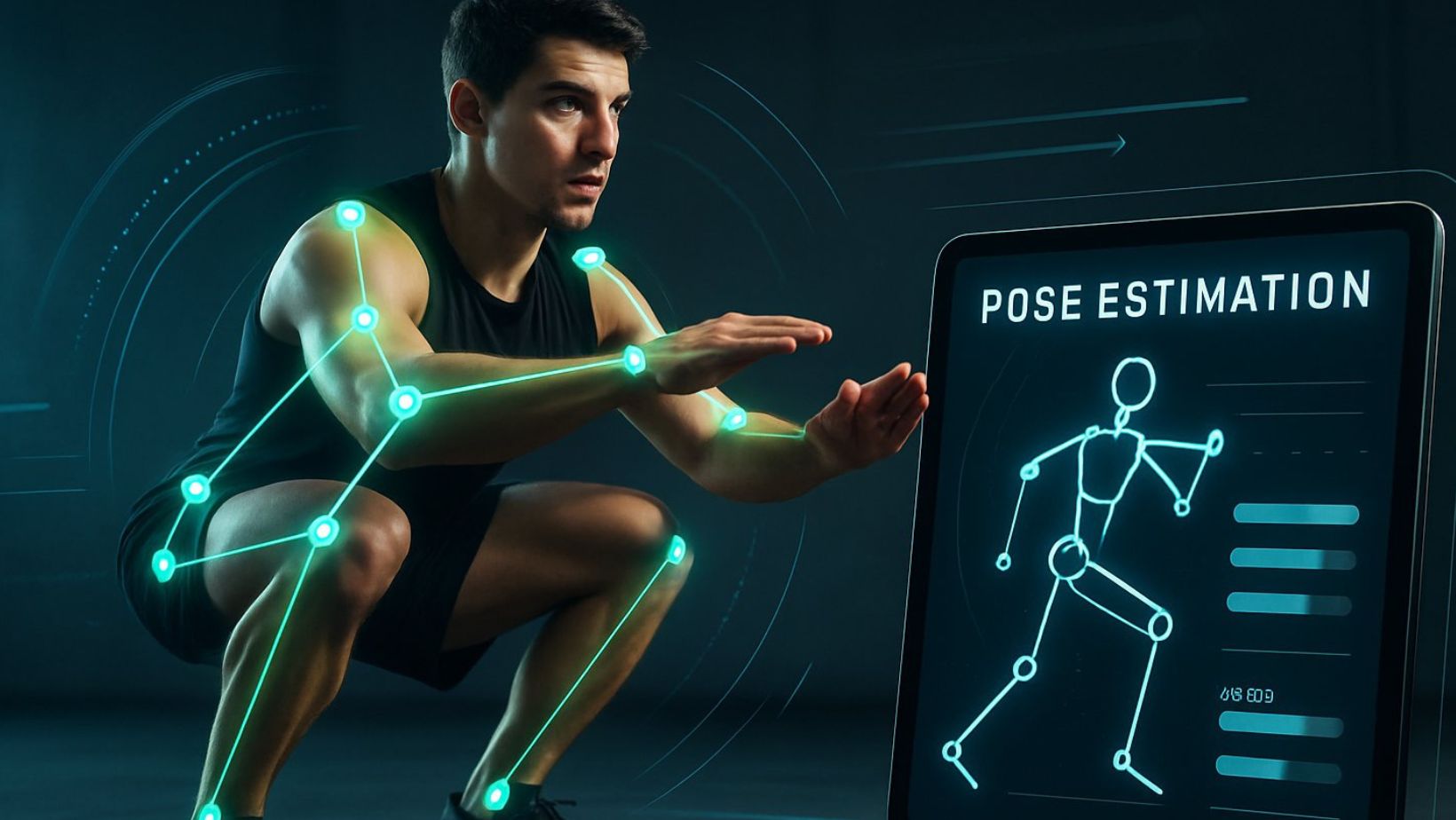
You could use your smartphone camera to inspect the accuracy of your squat. That’s an example of pose estimation with AI in action. This technology recognizes the movements of your body to provide you with feedback on the exercise you are doing.
This is happening right now in the world of fitness trackers and home workout platforms. This technology analyzes your movements, identifies errors before they develop into an injury, and motivates you to improve at a rate that would be impossible otherwise.
In this article, we explain how it works and why it’s important to your training.
What is Pose Estimation with AI?
Pose estimation AI relies on computer vision to detect and interpret the motion of your body. Point the camera at yourself while exercising, and the AI identifies key points in the body, such as the shoulders, elbows, hips, knees, and ankles, and tracks their movement in space.
It’s almost like having your own personal trainer who will never, ever get tired of checking your form.
Key Technologies Behind AI Pose Estimation
The secret to AI pose estimation technology lies in training deep learning models on thousands of hours of movement data. This data was used by the models to learn what constitutes proper form in various exercises, enabling them to detect improper movement.
How AI Pose EstimationWorks in Fitness
Pose estimation software breaks down movement analysis into three key components.
Real-Time Movement Tracking
You don’t have to wait until your workout is over to find out if your form was off.
AI pose estimation tools:
- Analyze your form while you’re moving
- Process video frames within milliseconds
- Give instant feedback so you can adjust mid-rep
Using a pose estimation app, you can avoid reinforcing bad habits through repetition.
Joint and Limb Tracking
AI pose estimation tools create a skeletal map of your body by identifying key anatomical points. It knows where your shoulders should be in a push-up, how far your knees should bend during a squat, and whether your spine is aligned properly during a deadlift.
The most important areas that pose estimation with AI tracks include:
- Major joints like the shoulders, elbows, hips, knees, and ankles
- Spine alignment and posture
- Head and neck positioning
- The angles and movement paths of your limbs
Motion Analysis
Pose estimation software also evaluates how your body is moving.
It looks at:
- Your full range of motion
- How quickly you perform each rep
- How accurately your body follows the intended movement path
Descending too fast? Not hitting the proper depth? The AI picks up on it and flags it instantly.
Key Benefits of AI Pose Estimation for Fitness
AI pose estimation tools deliver measurable improvements across every aspect of your training.
Improved Form and Posture
Pose estimation software helps you fix your form before it becomes a problem.
These tools:
- Catch small mistakes early
- Spot misalignment and uneven movement
- Help prevent injuries before they happen
Personalized Feedback
With AI pose estimation, you receive personalized tips based on your actual movements, rather than general advice.
This is achieved by:
- Watching your specific technique
- Giving tailored corrections
- Making cues more relevant and effective
Enhanced Workout Efficiency
When your form is better, your workouts work harder for you.
A pose estimation app:
- Focuses effort on the right muscles
- Reduces wasted reps
- Helps you make faster progress
Progress Monitoring
Thanks to pose estimation fitness tools, you can see how your movement improves over time without having to guess.
This detailed progress monitoring:
- Tracks joint mobility and range
- Shows changes in depth, posture, and control
- Turns your form into measurable data
Accessibility for All Fitness Levels
Whether you’re just starting out or training seriously, the AI adjusts to you.
It offers real personalization through:
- Adapting feedback to your skill level
- Keeping guidance simple when needed
- Supporting both beginners and experienced users
Applications of AIPose Estimation in Fitness
AI pose estimation tools show up in five main areas of fitness and wellness.
Workout Guidance and Coaching
AI-powered apps act as virtual trainers by:
- Guiding you through exercises
- Watching how you perform
- Correcting your form in real time
It’s not quite the same as having a coach beside you, but it’s a big step up from guessing on your own.
Home Fitness Apps
Doing workouts at home used to mean giving up on form feedback. That’s no longer the case. Pose estimation software brings real coaching into your living room, with no gym membership or personal trainer required.
Rehabilitation and Injury Prevention
Physical therapists utilize this technology to remotely monitor patients. It checks whether you’re doing rehab exercises properly and flags any compensations that could slow down healing or lead to reinjury.
Wearable Devices
Some smartwatches and fitness trackers now include pose estimation fitness features. They track your form during workouts and alert you if your running stride changes or if fatigue is affecting your lifting posture.
Gamification and Motivation
AI-powered fitness games use pose estimation neural networks to score your movements. Hit your targets, rack up points, and challenge friends. It turns form practice into something that feels more like a game than a chore.
How AI Pose EstimationEnhances Specific Fitness Activities
Different types of workouts benefit from pose estimation with AI in unique ways:
| Activity | How Pose Estimation Software Helps |
| Strength Training | Tracks bar path and joint angles, measures squat and lunge depth, checks back position during deadlifts |
| Yoga & Pilates | Helps with alignment, monitors balance, tracks flexibility improvements, adjusts pose depth |
| Cardio | Analyzes running stride, cycling posture, overall movement efficiency, and signs of fatigue |
| Stretching | Measures your range of motion, helps prevent overstretching, and logs flexibility progress |
Integrating AI Pose Estimation into Your Fitness Routine
Taking advantage of pose estimation neural network technology is simpler than you might think.
Getting Started
You don’t need fancy equipment to begin. Most AI fitness apps work with just your smartphone camera.
- Position your phone so it captures your full body
- Launch the pose estimation app
- Start moving
- AI takes care of the rest

Popular options include:
- Smartphone apps with built-in pose tracking
- Smart mirrors offering AI-powered coaching
- Wearables with motion analysis features
- Connected home gym systems
Setting Goals
Use the data from pose estimation to set clear, measurable fitness targets. Instead of vague goals like “fix my form,” try objectives like:
- Increase squat depth by 10%
- Achieve even, balanced push-up form
- Keep a neutral spine through 95% of deadlift reps
Tracking Progress
The AI automatically records your performance over time. By reviewing trends weekly, you can clearly see what’s improving and where you’re plateauing. It removes the guesswork from your training.
Combining AI with Traditional Coaching
AI won’t replace your coach, but it can support them. Use AI pose estimation tools for regular form checks and real-time feedback, and rely on human trainers for personalized program design, motivation, and the kind of coaching insight that AI cannot yet replicate.
Challenges and Limitations of Pose Estimation AI
Like any technology, pose estimation software has its limitations.
Accuracy and Precision
AI pose estimation isn’t flawless. Poor lighting, low camera resolution, or complex movements can reduce tracking accuracy. If you’re wearing baggy clothes or standing in front of a cluttered background, the system might have trouble recognizing your body correctly.
For the best results:
- Use strong, natural lighting
- Wear fitted clothing that clearly shows your body shape
- Keep the background clean and free of distractions
- Make sure your full body is visible to the camera
User Privacy and Data Security
Recording and sending video to an app naturally raises concerns about privacy.
Always check:
- What data the app collects
- Where it’s stored
- Whether it’s shared
Some pose estimation fitness apps process everything locally on your device, which tends to be safer than sending it to the cloud.
User Adaptation
If you’re used to training without feedback, getting constant AI corrections can feel like a lot at first. Instead of trying to fix everything at once, start with small steps. Focus on one or two form issues, and ease into the feedback-driven approach.
About the Author