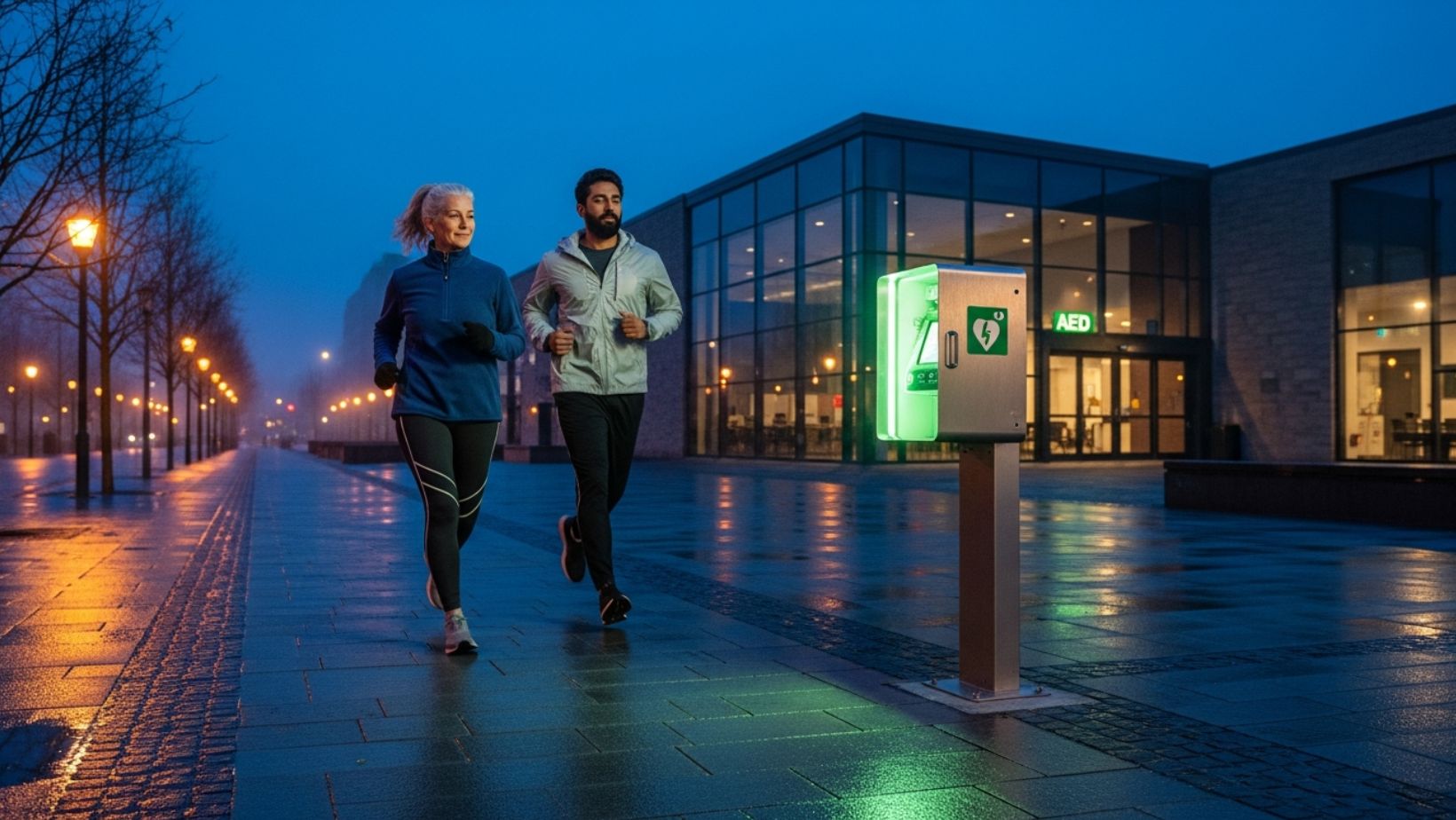
Approximately 60,000 out-of-hospital cardiac arrests occur in Canada each year—about one every nine minutes. While clinical data indicate that between 80% and 85% of all sudden cardiac arrests happen at home, incidents taking place in public spaces present a unique logistical challenge for emergency medical response. The current public health infrastructure relies heavily on automated external defibrillators placed inside commercial and municipal buildings, creating a severe accessibility issue after business hours. Addressing this vulnerability makes continuous, around-the-clock outdoor access a clinical necessity for community safety. Implementing purpose-built infrastructure guarantees that life-saving technology remains available outside of standard operating hours, drastically improving survival odds for cardiology patients. As we advance into 2026, relying exclusively on indoor storage for life-saving medical equipment constitutes a preventable failure in emergency preparedness.
The Mechanics of the Chain of Survival in 2026
The Critical 10-Minute Response Window
The physiological reality of a sudden cardiac arrest dictates a strict timeframe for medical intervention. The Heart and Stroke Foundation highlights a “10-minute window” where immediate response determines survival and recovery levels. Clinical guidance consistently underscores that for every minute defibrillation is delayed, the chance of survival decreases by 7-10%. Currently, the baseline survival rate for an out-of-hospital cardiac arrest hovers around a historically low 10%. However, when cardiopulmonary resuscitation and an automated external defibrillator are used within the first few minutes, survival rates can surge to 70% or higher. Furthermore, clinical observational studies firmly demonstrate that victims who receive a shock from a publicly available device administered by a bystander have 2.62 times higher odds of survival to hospital discharge compared to those who wait for emergency medical services. Relying solely on paramedic dispatch during a public cardiac emergency is statistically insufficient to secure the best possible clinical outcome. Equipping bystanders with immediate access to defibrillation technology forms the essential physical bridge between a sudden cardiac event and professional medical intervention.
Beyond the immediate statistical probabilities, the physiological impact of prolonged oxygen deprivation on the brain requires rapid bystander intervention. The American Heart Association explicitly notes that 9 in 10 cardiac arrest victims who receive a shock from an AED in the first minute live. The human brain begins to suffer irreversible neurological damage within just four to six minutes after the heart stops pumping oxygenated blood. Because average emergency medical service response times frequently exceed this biological limit, waiting for an ambulance is highly dangerous for patients. Recognizing this severe clinical reality, the American Heart Association confirms that over 350,000 out-of-hospital cardiac arrests occur each year in the US, making it a prominent public health crisis. Immediate bystander action effectively stalls the dying process, preserving brain function until advanced life support measures can be fully administered by arriving paramedics.
Identifying the Accessibility Gap in Public Spaces
The Danger of After-Hours Lockouts
A major limitation in conventional community health planning is the placement of emergency devices exclusively inside businesses, schools, and recreational centers. A detailed Toronto study revealed that 21.5% of out-of-hospital cardiac arrests occurred near a public AED that was inaccessible at the time, with coverage loss spiking to 31.6% during evenings, nights, and weekends. Despite considerable financial investments in public-access defibrillation programs, Canada’s bystander utilization rate in public places remains alarmingly low at only 13%. Medical professionals emphasize that system-level innovations are required to minimize these avoidable delays and expand equitable access to early defibrillation. When examining the broader North American landscape, similar logistical vulnerabilities present themselves repeatedly across multiple jurisdictions. Facility managers typically lock commercial and public doors at the end of the business day, inadvertently placing life-saving equipment completely out of reach. Solving this structural issue requires municipal leaders to prioritize uninterrupted exterior placement strategies.

To fully understand the current accessibility crisis, healthcare advocates and urban planners must identify the primary logistical barriers restricting effective equipment utilization. Current operational practices severely limit bystander intervention, especially during the crucial moments before professional medical responders arrive on the scene. For example, recent national polling indicates that only about half of parents know if their child’s school has an AED, and fewer know its location, demonstrating the inherent flaw of hiding devices indoors. When medical equipment remains invisible or inaccessible behind locked doors, communities suffer preventable fatalities. Addressing these systemic deficiencies requires a thorough evaluation of how public spaces currently handle emergency medical storage. The most prominent obstacles restricting bystander intervention include:
- Restricted Operating Hours: Devices locked inside municipal buildings or schools become useless after 5:00 PM and on weekends, cutting off access when public spaces are often busiest.
- Lack of Public Awareness: Communities frequently remain unaware of placement locations, prompting reliance on platforms like the PulsePoint app to map out unregistered devices or alert users to nearby cardiac events.
- Vandalism Concerns: Fear of theft and property damage routinely leads facility managers to hide equipment out of plain sight, an issue experienced by communities forced to replace vandalized units.
- Environmental Limitations: Standard medical electronics cannot withstand freezing temperatures or high heat, forcing property owners to keep them indoors.
| Placement Strategy | Visibility | Accessibility | Environmental Protection | Vandalism Deterrence |
| Traditional Indoor Wall Cabinet | Low (Hidden off-hours) | Restricted (Business hours only) | High (Climate-controlled building) | High (Locked inside buildings) |
| Unprotected Outdoor Cabinet | Moderate | 24/7 | Low (Prone to extreme heat/freezing) | Low (Easily damaged) |
| Purpose-Built Outdoor Tower | High (Brightly lit, freestanding) | 24/7 | High (Internal heating/ventilation) | High (Alarmed, durable construction) |
Modernizing Public Health Infrastructure with All-Weather Solutions
Overcoming Environmental Constraints
Municipalities across North America are increasingly prioritizing outdoor, around-the-clock accessibility to combat the structural limitations of indoor storage. For instance, Dubuque, Iowa, is actively installing 11 new units in city parks, signaling a shift toward robust community health planning. Similarly, the Omaha Parks Foundation has successfully raised funds to replace aging equipment at 13 outdoor public pools. On a broader legislative scale, lawmakers are recognizing the urgency, as seen with a bill in the Virginia General Assembly that would require automated external defibrillators at all sporting facilities and events. Transitioning these delicate medical instruments to outdoor environments requires specialized, weather-proof infrastructure to maintain battery integrity. Without adequate protection from the elements, cold temperatures, and extreme heat will rapidly degrade battery life and destroy vital electrode pads.
The SaveStation Tower AED Cabinet Advantage
The SaveStation Tower AED cabinet is a specialized outdoor enclosure designed specifically to solve this accessibility crisis in 2026. As a free-standing, highly visible pillar of public health infrastructure, it allows local communities to take cardiac safety firmly into their own hands. Placing this freestanding structure in highly trafficked outdoor environments, such as public parks, sports fields, and town squares, guarantees that life-saving technology is immediately identifiable. Bystanders can locate the device instantly, drastically reducing the time spent searching for equipment during a sudden, high-stress cardiac event. By moving defibrillation technology out of locked buildings and into the open, the enclosure acts as a constant, reassuring visual reminder of community preparedness. Local policymakers utilizing this specific infrastructure directly eliminate the overnight accessibility gaps that plague traditional placement strategies.
From a strictly clinical and structural standpoint, the enclosure features essential climate control mechanisms, including built-in ventilation and heavy-duty heating components. These rigorous climate safeguards protect the highly sensitive medical components of any automated external defibrillator on the market from harsh freezing winter temperatures and extreme summer heat. Maintaining a stable internal temperature ensures that the medical device will function properly upon deployment, preventing equipment failure when a patient’s life is on the line. Furthermore, the specialized tower enclosure guarantees unhindered 24/7 accessibility for anyone in the vicinity. It comes completely outfitted with a brightly lit topper that ensures immediate visual identification during nighttime emergencies or low-light conditions. This continuous illumination acts as a beacon for bystanders and emergency dispatchers, fundamentally altering how communities approach out-of-hospital cardiac arrest survival.
Addressing long-standing security concerns and prioritizing community engagement, the cabinet effectively deters vandalism through highly visible built-in lighting and a loud audible alarm that triggers immediately upon opening. This acoustic alert signals to nearby individuals that a medical emergency is taking place while simultaneously discouraging tampering or theft. The thoughtfully designed structure also offers dedicated exterior space for high-quality sponsor advertising on both the front and back panels. This specific design feature makes community-funded neighborhood programs highly viable, allowing local businesses and civic organizations to financially sponsor units. By sharing the acquisition costs, neighborhoods can easily deploy these towers across public parks and athletic fields while maintaining the long-term financial sustainability of the program. Ultimately, this collaborative approach shifts the burden of emergency preparedness from isolated facility managers directly to an engaged, proactive community.
Advancing Community Cardiac Safety
Minimizing the time between a sudden cardiac arrest and the application of an electrical shock requires unhindered, 24/7 access to life-saving technology. Keeping essential medical equipment locked inside commercial and municipal facilities overnight structurally limits bystander intervention and drastically lowers overall survival metrics. Empowering everyday citizens with highly visible, all-weather outdoor enclosures will dramatically alter the survival landscape for cardiology patients in 2026 and beyond. A strategically placed, well-protected device ensures that anyone, regardless of formal medical training, can administer a restorative shock long before emergency medical responders arrive on the scene. For further insights into optimizing community health infrastructure and navigating comprehensive cardiac care plans, consult our extensive online resource library.
About the Author