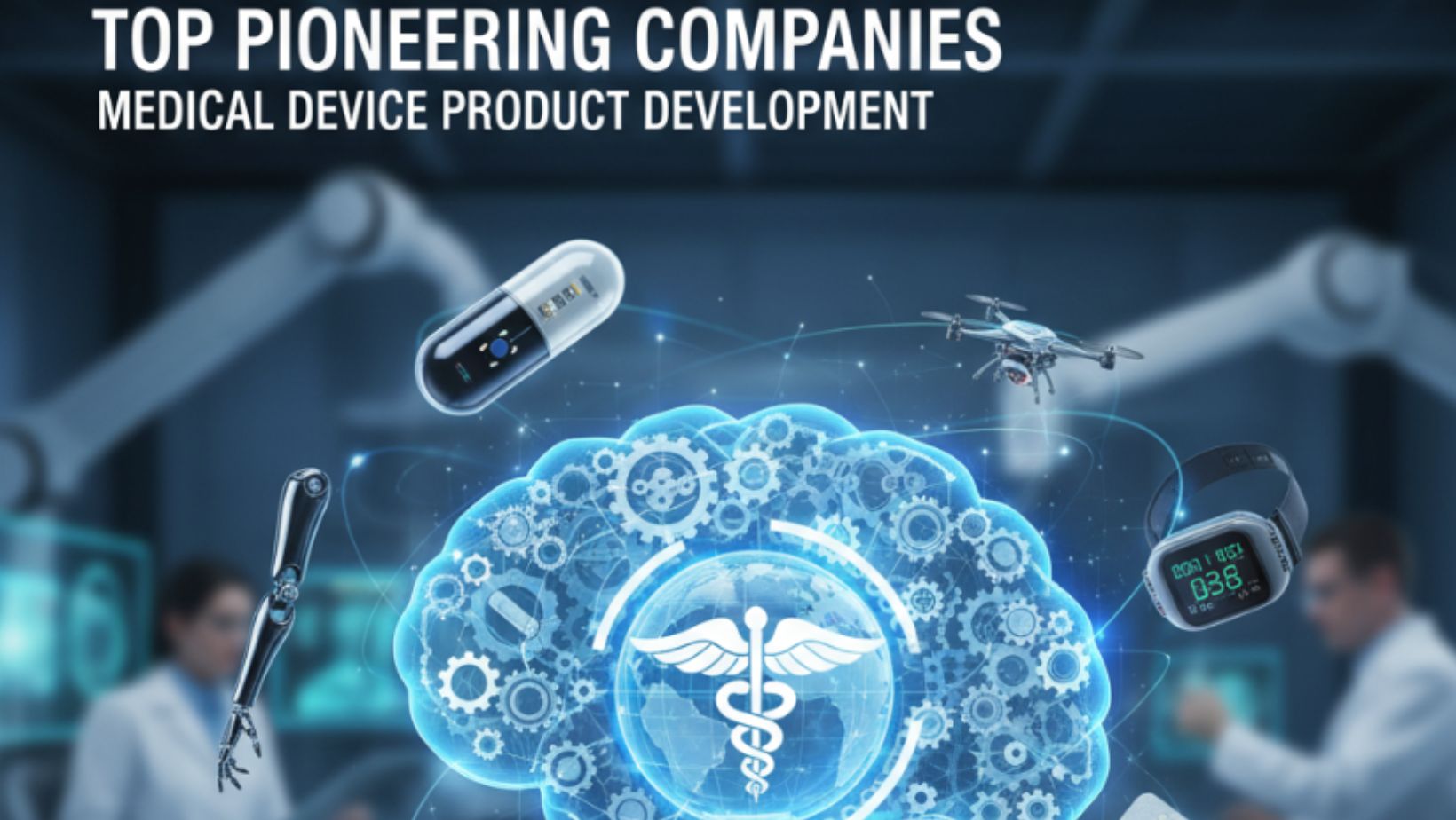
The medical device industry is experiencing unprecedented innovation velocity, with the global medical device market valued at $518 billion in 2023 and projected to reach $886 billion by 2030. This expansion is driven by rising chronic disease prevalence, aging populations, and technological breakthroughs in connected diagnostics, robotic surgery, neuromodulation, and AI-augmented therapeutics.
Success in this landscape requires partners who combine deep regulatory expertise, comprehensive technical capabilities spanning hardware, firmware, and software integration, manufacturing excellence, and proven clinical validation pathways.
Industry Leaders and Established Pioneers
1. Medtronic

Medtronic, founded in 1949 and headquartered in Minneapolis, Minnesota, stands as the global frontrunner in medical device innovation, with $33 billion in annual revenue and dominant market positions in cardiac devices, diabetes management, and neurotechnology. The company has pioneered the integration of intelligent software with sophisticated medical device hardware, establishing the gold standard for connected medical device ecosystems.
Medtronic’s distinctive competence lies in seamlessly integrating medical device hardware with advanced software platforms, enabling remote patient monitoring, predictive analytics, and automated therapy optimization. The company produces implantable defibrillators, pacemakers, and advanced monitoring systems enabling physicians to remotely manage patients’ cardiac conditions. In diabetes management, Medtronic has pioneered insulin pump technology and continuous glucose monitoring systems, now integrating AI algorithms enabling automated insulin delivery and diabetes prediction.
2. Siemens Healthineers

Siemens Healthineers, with $23 billion in revenue and 69,500 employees, represents a distinctive pioneer in AI-augmented diagnostic imaging software and clinical workflow platform integration. The company has transformed from a traditional imaging equipment manufacturer to an integrated diagnostics and clinical operations platform provider.
With over 85 AI-powered products, Siemens Healthineers uses machine learning to enhance diagnostic accuracy across CT, MRI, X-ray, and ultrasound modalities, reducing clinician workload while improving diagnostic reliability. The company implemented Teamcenter Product Lifecycle Management (PLM) integration as a digital backbone connecting R&D, manufacturing, regulatory compliance, and supply chain management across 700,000 installed systems and 17 million regulatory documents globally.
Siemens Healthineers pioneered virtual simulation of physical systems enabling early design validation, accelerated time-to-market, and introduction of “patient twins”, AI-personalized digital models enabling precision medicine and population health insights.
Specialized Development and Engineering Partners
1. StarFish Medical
StarFish Medical, headquartered in Canada with offices in Toronto and Victoria, represents a pioneering specialist in full-lifecycle medical device product engineering, combining product definition expertise with advanced prototyping and low-volume manufacturing.
The company developed proprietary Pathfinder™ Process methodology streamlining medical device product definition and optimizing commercialization pathways, reducing development risk and accelerating market entry. StarFish maintains specialized competence across diagnostics including ultrasound, optics, sensors, implantable diagnostics, drug delivery systems, and therapeutic devices.
StarFish operates ISO 13485-certified manufacturing facilities in Toronto and Victoria including cleanroom capabilities, enabling seamless transition from prototype validation to low-volume production with full regulatory compliance. The team combines FDA and Health Canada filing expertise with deep knowledge of IEC 60601 electrical safety standards and ISO 13485 quality management system requirements.
2. HTD Health
HTD Health represents an emerging pioneer in Software as a Medical Device (SaMD) development with explicit focus on combining modern Agile practices with FDA and EU MDR compliance. Rather than treating compliance as a post-development checklist, HTD implements regulatory thinking throughout iterative sprints, ensuring each development cycle maintains compliance documentation while enabling rapid product evolution.
HTD achieved ISO 13485 certification, validating organizational maturity in medical device quality management. The company demonstrates full compliance with EU MDR and US FDA regulations, implementing rigorous design controls, risk management, and verification/validation protocols throughout development. HTD recognizes that integrated compliance methodologies accelerate rather than impede development, enabling faster regulatory submissions and smoother market launches.
3. NAMSA
NAMSA (North American Science Associates), founded in 1957, operates as the world’s largest contract research organization (CRO) focused exclusively on medical devices and in vitro diagnostics. With 1,400 specialists conducting research on 3,000+ medical devices annually, NAMSA brings an unmatched breadth of experience.
Rather than fragmenting services across preclinical testing, clinical trials, biological safety evaluation, and regulatory submissions, NAMSA delivers a holistic regulatory strategy with a detailed timeline and cost projections from preclinical research through post-market compliance. The company operates GLP-compliant and AAALAC-accredited facilities in the United States and Europe, conducting biocompatibility testing, surface treatments such as hydrophilic coating, histopathology, sterilization validation, and shelf-life testing.
NAMSA’s global clinical trial network enables efficient, safe, and effective clinical research across diverse geographies and patient populations. The company provides comprehensive consulting spanning FDA pathways, including PMA, 510(k), De Novo, and IDE, alongside EU MDR/IVDR requirements, biological safety evaluation, and post-market surveillance.
4. Plexus
Plexus, a global electronics manufacturing services leader, has pioneered specialized expertise in complex medical device manufacturing and product lifecycle management, spanning design, prototyping, scale-up, and long-term manufacturing support.
Plexus brings decades of experience with complex medical device manufacturing, including imaging systems, cardiac monitoring devices, therapeutic systems, and healthcare management platforms. From concept through market and beyond, Plexus provides integrated support combining R&D partnership, design optimization, manufacturing scalability, and aftermarket lifecycle management.
The company combines user-centered design, full-system engineering, and rigorous quality management with accelerated time-to-market through global resources and integrated processes. Plexus maintains particular expertise in next-generation surgical systems, medical robotics, and powered disposable instruments.
Specialized Software and Hardware Integration Leaders
1. Yalantis
Yalantis, headquartered in Warsaw, Poland, has emerged as a distinctive pioneer in integrated medical device development, combining hardware, firmware, cloud platforms, mobile applications, and regulatory expertise within single cross-functional teams.
The company reports a 90% first-pass FDA approval rate and 50+ FDA and CE approvals, demonstrating a consistent ability to navigate regulatory submission pathways successfully. Rather than fragmenting development across separate hardware, firmware, and software teams, Yalantis delivers coordinated hardware-to-cloud solutions, eliminating communication silos and accelerating development velocity.
Yalantis implements comprehensive regulatory frameworks for medical device development:
- IEC 62304 software lifecycle standards ensure systematic development processes
- FDA 510(k) and De Novo submission support with documented success rates
- EU MDR compliance with clinical evaluation and technical documentation
- Custom ISO 13485 Quality Management Systems tailored to client needs
- Risk management protocols following ISO 14971 standards
The company demonstrates particular expertise in Medical Internet of Things (MIoT) ecosystems, including sensor integration, connectivity management, edge computing, and cloud analytics for remote patient monitoring. Yalantis integrates sensors for medical devices with sophisticated data processing pipelines, enabling real-time health monitoring and predictive analytics.

Yalantis embeds Protected Health Information (PHI) safeguards with encrypted transmission, audit logging, access controls, and Business Associate Agreements throughout development. The company provides machine learning models for diagnostics and predictive analytics, AI algorithm integration, FDA SaMD regulatory guidance, and Tiny ML development for resource-constrained medical devices.
2. Syrma Johari MedTech
Syrma Johari MedTech, headquartered in India with international distribution, represents 40+ years of medical device manufacturing heritage with distinction as the first Indian manufacturer of FDA-compliant medical devices, achieving FDA clearance in 1986.
The company maintains FDA, GMP, and MDSAP certifications with state-of-the-art Class 100,000 cleanroom facilities. Over decades, Syrma Johari achieved 15+ FDA clearances for electromedicine, physiotherapy, and medical aesthetic devices, demonstrating consistent ability to navigate regulatory approval for diverse technology categories.
Syrma Johari provides concept design, prototyping, electronics/mechanical engineering, system integration, and packaging/supply chain management within a coordinated development process. The company emphasizes cost-optimized manufacturing through Design for Manufacturing (DFM) principles and value engineering, enabling fast go-to-market while maintaining ISO 13485 compliance.
Fastest-Growing Medical Device Innovators
1. Inspire Medical Systems
Inspire Medical Systems, based in Minnesota, pioneered implantable devices stimulate airway muscles during sleep to treat obstructive sleep apnea, an alternative to traditional CPAP machines. The company expanded to 1,435 treatment centers with 90,000+ patients treated and is preparing the launch of the next-generation Inspire V system.
2. Senseonics
Senseonics, headquartered in Maryland, pioneered long-term implantable continuous glucose monitoring (CGM) systems, culminating in the launch of Eversense 365, the first CGM designed to function for a full year with a single sensor. The company expanded its global patient base by 56% with regulatory expansion underway in Europe.
Critical Success Factors for Medical Device Product Development
Organizations selecting medical device development partners should prioritize proven regulatory track records with documented FDA and CE approval success across multiple device classifications, including verifiable first-pass approval rates and submission timelines.
Integrated capability across hardware, firmware, software, and cloud is essential, as medical devices increasingly require sophisticated integration across multiple technology domains. Leading partners should demonstrate coordinated expertise rather than fragmented subcontracting.
Compliance should be embedded throughout development rather than treated as a final-stage requirement. Partners should implement regulatory thinking from concept through manufacturing, ensuring design decisions align with regulatory expectations from inception.
Development partners should demonstrate the ability to transition prototypes to production manufacturing while maintaining quality and cost targets. Manufacturing scale-up excellence separates theoretical design capabilities from practical commercialization success.
Partners should demonstrate experience conducting clinical trials, generating real-world evidence, and supporting post-market surveillance, essential for long-term regulatory compliance and market success. For organizations pursuing multiple geographic markets, partners should demonstrate mastery of FDA, EU MDR, Health Canada, PMDA (Japan), and NMPA (China) requirements rather than a single-region focus.
The pioneering firms profiled above represent the ecosystem of expertise enabling medical device developers to navigate increasingly complex regulatory landscapes while maintaining innovation velocity and bringing life-saving technologies to patients globally.
About the Author